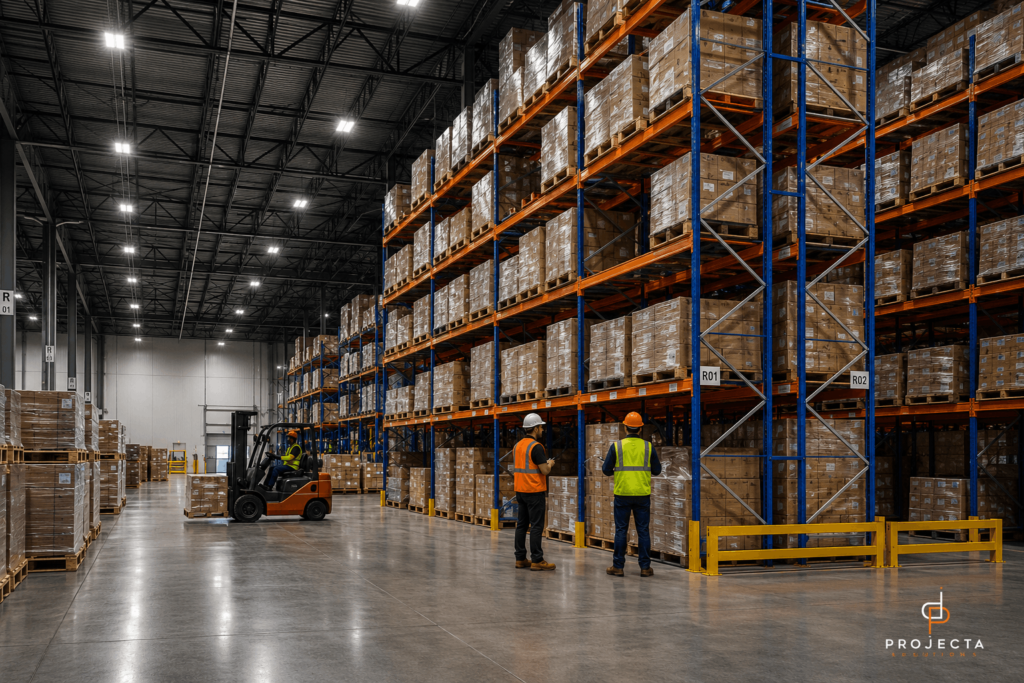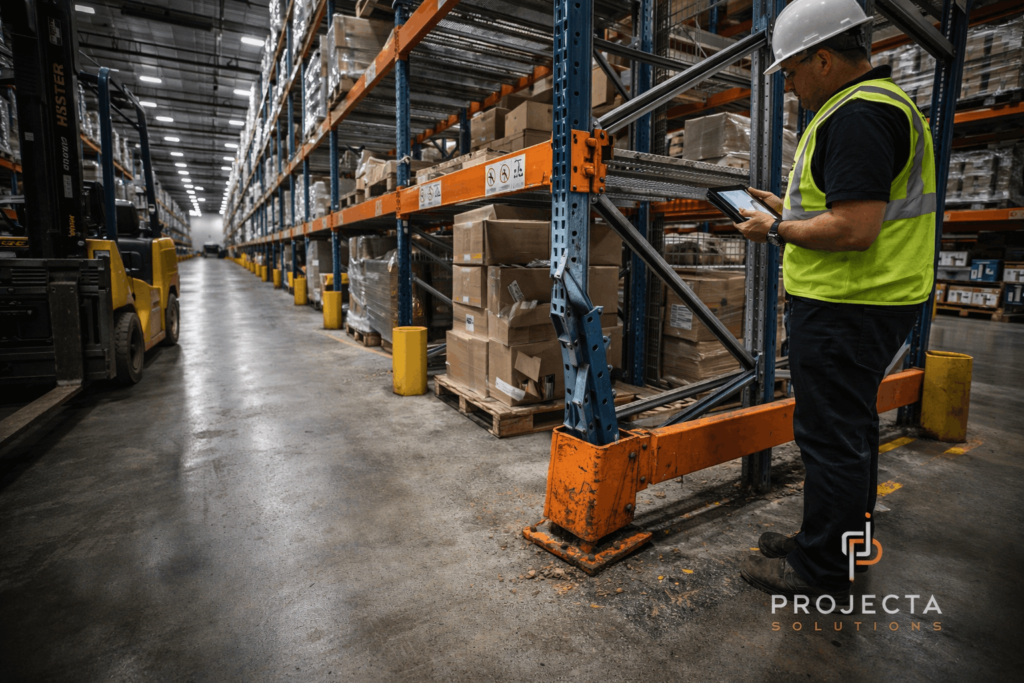
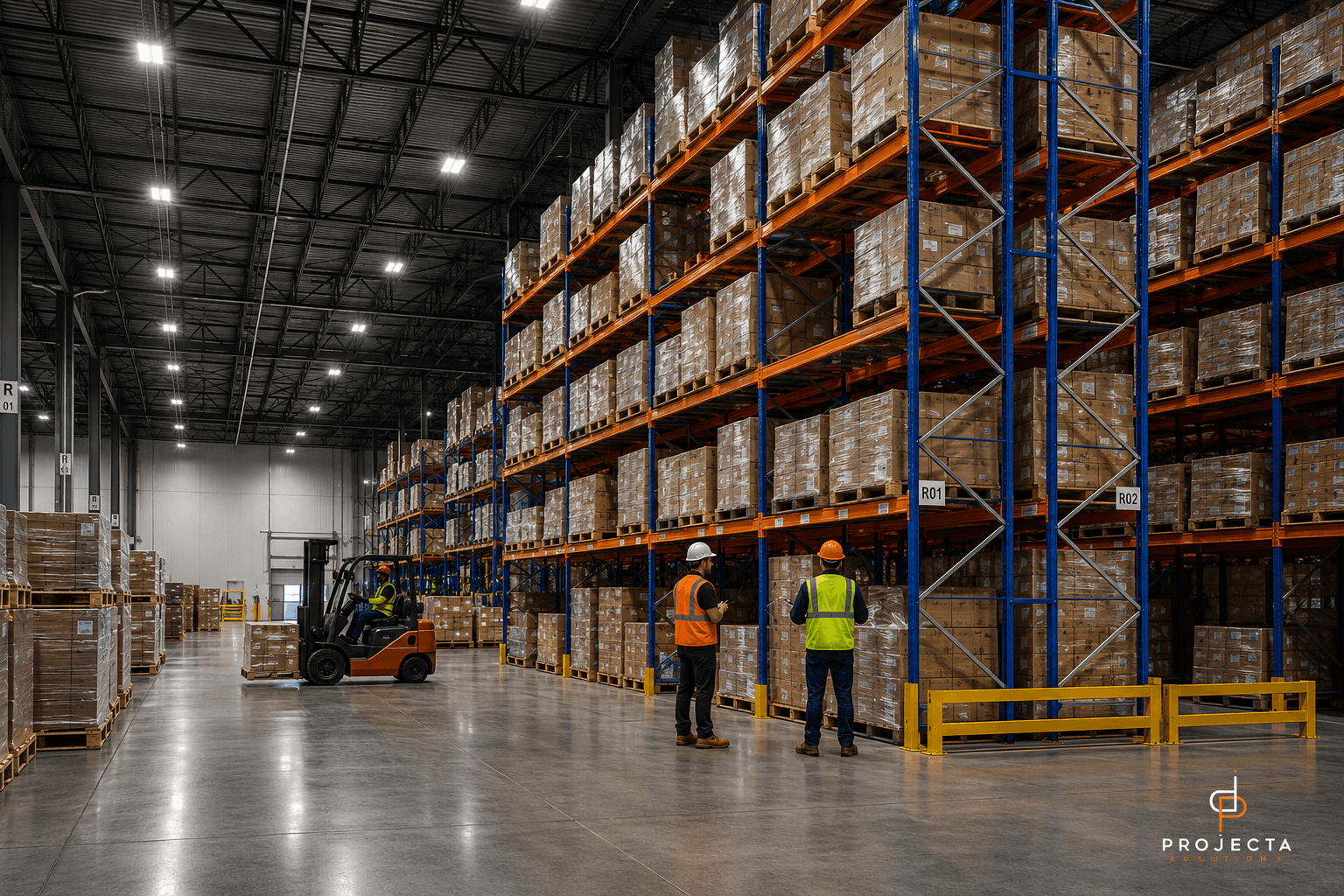
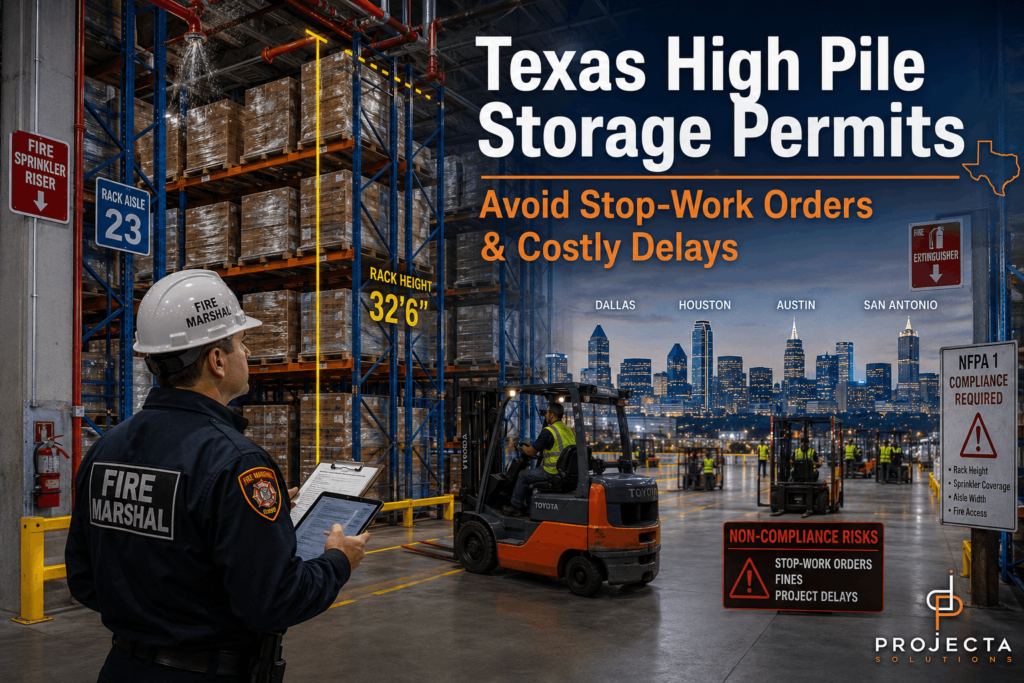
If your Texas warehouse stores goods above 12 feet or above 6 feet for high-hazard materials, you are legally required to obtain a high pile storage permit before operations begin. Skipping this step can result in an immediate stop-work order from the fire marshal, substantial fines, and costly project delays that ripple across your entire supply chain.
This guide explains exactly when a high pile storage permit is required in Texas, what documents you need, how the process works in Dallas-Fort Worth, Houston, Austin, and San Antonio, and how Projecta Solutions manages the entire permitting process for you from start to final inspection approval.
What is a High Pile Storage Permit in Texas?
The local fire marshal’s office issues a high pile storage permit to authorize a facility to store combustible or non-combustible materials in stacks or racks above a certain height threshold. It is separate from a standard building permit and is governed by the International Fire Code (IFC) Chapter 32 as adopted by Texas municipalities, alongside local amendments and NFPA (National Fire Protection Association) standards.
The permit exists because high-stacked materials significantly increase fire risk, obstruct sprinkler coverage, create heat channels that accelerate fire spread, and complicate fire department access. The permitting process ensures your facility’s storage configuration, sprinkler system, and emergency access are all compliant before you begin operations.
Do You Need a High Pile Storage Permit? — Quick Checklist
If two or more of the following apply to your Texas warehouse, you almost certainly need a high pile storage permit. This is not a complete legal determination; always confirm with your local jurisdiction, but it’s a reliable starting point:
- Storage racks or stacks exceed 12 feet in height (or 6 feet for Class III–IV high-hazard commodities)
- High pile storage area exceeds 500 square feet
- The facility is used as a warehouse, distribution center, or 3PL operation
- You store flammable liquids, aerosols, plastics (Group A), or other high-hazard commodities
- Your facility is located in Dallas, Houston, Austin, San Antonio, Fort Worth, or any Texas municipality that has adopted the IFC
- You are changing the use, commodity classification, or rack height of an existing permitted facility
| ⚠️ IMPORTANT
The fire marshal issues the high pile storage permit as a separate requirement, even if you already have a building permit for your racking installation. Many Texas warehouses have valid building permits but operate without the required high pile storage permit, and discover this only when the fire marshal conducts a routine inspection. |
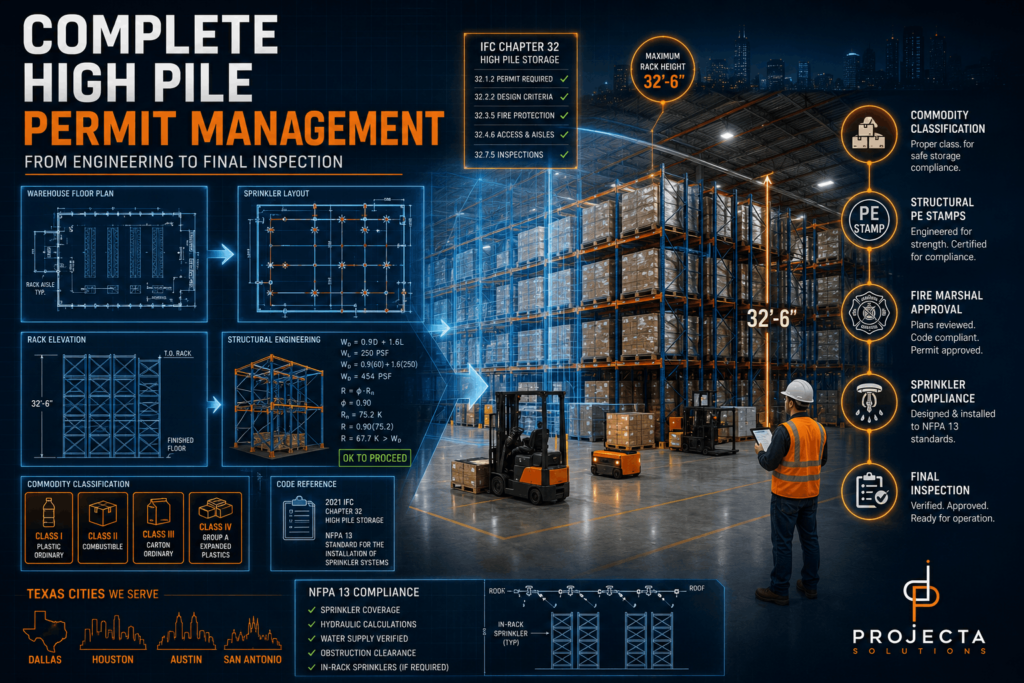
High Pile Storage Permit Requirements by Texas City
Texas municipalities each adopt and amend the IFC independently. Here’s how requirements differ across the major Texas markets Projecta Solutions serves:
| City | Height Threshold | Area Threshold | Governing Authority |
| Dallas / DFW | 8 feet and above | 500+ sq ft high pile area | Dallas Fire-Rescue / City of Dallas |
| Houston | 12 feet (6 ft for high-hazard) | 500+ sq ft | Houston Fire Dept — IFC Ch. 32 |
| Austin | 8 feet and above | 500+ sq ft | Austin Fire Department |
| San Antonio | 8 feet and above | 500+ sq ft | COSA Fire Marshal’s Office |
Note: Houston enforces the 2021 Houston Fire Code Chapter 32, which is one of the most detailed high pile storage frameworks in Texas. Dallas and Austin follow IFC 2021 with local amendments. Requirements can change — always verify current thresholds with your Authority Having Jurisdiction (AHJ) before beginning design.
Commodity Classification: The Step Most Warehouses Get Wrong
Before any permit application can be filed, your stored products must be classified by commodity class according to the IFC. This classification determines your height thresholds, sprinkler requirements, and storage array limits. Getting it wrong delays your permit and can require redesigning your entire rack layout.
| Commodity Class | Description | Height Threshold (General) | Examples |
| Class I | Non-combustible products in non-combustible packaging | Up to 25 ft (varies) | Canned goods, glass, and metal parts |
| Class II | Non-combustible products in slatted wood crates | Up to 25 ft (varies) | Wine in wood crates, hardware |
| Class III | Wood, paper, and natural fiber products | Up to 25 ft (varies) | Clothing, furniture, paper goods |
| Class IV | Class I–III with limited plastics | Up to 25 ft (varies) | Mixed retail consumer goods |
| High Hazard (Group A Plastics) | Expanded foam, Group A plastics | 6-foot triggers permit | Foam packaging, plastic bins, tires |
If your inventory includes Group A plastics, which includes many common warehouse materials like foam packaging, empty plastic pallets, and plastic bins, your trigger height drops to just 6 feet. This catches many Texas warehouses off guard.
Documents Required for a Texas High Pile Storage Permit
This is where most permit applications stall. Incomplete submittals are the single biggest cause of delays in Texas warehouse permitting. Our engineering and permitting team prepares every document in-house. Here is what a complete Texas high pile storage permit application requires:
- Floor Plan & Rack Layout: Full AutoCAD floor plan showing rack locations, aisle dimensions, storage heights, number of tiers, and high pile storage area boundaries
- Commodity Classification Documentation: Written description of all commodities stored, their classification, and storage locations within the facility
- Structural Engineering Calculations: PE-stamped load calculations confirming rack structural integrity under design loads — required for all systems above certain heights
- Sprinkler System Plans: Fire protection drawings confirming sprinkler head locations, coverage, and water supply adequacy for high pile storage configurations
- Ceiling Clearance Verification: Documentation showing 18–24 inch minimum clearance between the top of the storage and sprinkler deflectors
- Fire Department Access Documentation: Floor plan marking fire department access doors, apparatus roads, and smoke vent locations
- Emergency Egress Plan: Evacuation plan for the facility in the event of fire
- Completed Permit Application: City-specific forms, filing fees ($200–$1,500 depending on jurisdiction), and contractor license documentation
| 💡 WHY MOST APPLICATIONS GET REJECTED ON FIRST SUBMISSION
The most common rejection reasons are: (1) missing PE stamp on structural calculations, (2) sprinkler system plans not updated to reflect new rack heights, (3) commodity classification that doesn’t match actual products stored, and (4) aisle widths that don’t meet fire access requirements. Our team reviews all documents before submission to eliminate these issues. |
Step-by-Step: How to Get Your High Pile Storage Permit in Texas
Here is the complete process our team follows on every Texas high pile storage permit project:
- Step 1: Commodity Classification Audit: Identify and classify every product category stored in your facility. Determine your highest-hazard commodity class — this sets your height threshold and sprinkler requirements.
- Step 2: AutoCAD Warehouse Layout Design: Produce a detailed floor plan showing rack layout, aisle widths, storage heights, tier counts, and high pile storage area boundaries. This drawing forms the foundation of your entire permit application.
- Step 3: Structural Engineering: A licensed PE reviews your rack system design, performs load calculations, and stamps the structural drawings. This is required in every major Texas city.
- Step 4: Fire Protection Review: Confirm your sprinkler system is adequate for the proposed storage configuration. If you need modifications, coordinate with your sprinkler contractor before filing.
- Step 5: Fire Marshal Submittal: Submit the complete application package to the local fire marshal’s office. In Houston, this goes to the Houston Fire Department; in Dallas, to Dallas Fire-Rescue; in Austin, to the Austin Fire Department.
- Step 6: Plan Review & Revisions: The fire marshal reviews the submittal and may request clarifications or revisions. Our team responds and resubmits until approval is granted.
- Step 7: Permit Issuance & Inspection: Once approved, the permit is issued. After the racking installation is complete, the fire marshal conducts a final inspection to verify that the installed system matches the approved drawings.
How Long Does the High Pile Permit Process Take in Texas?
Timeline varies significantly by city and by the completeness of your initial submittal:
| City | Typical Timeline (Complete Submittal) | Common Delay Causes |
| Dallas / DFW | 3 – 5 weeks | Incomplete structural calcs, commodity classification errors |
| Houston | 4 – 8 weeks | One of the most detailed review processes in Texas |
| Austin | 2 – 5 weeks | Missing fire department access documentation |
| San Antonio | 3 – 6 weeks | Sprinkler system plan deficiencies |
An incomplete submittal can add 4–12 additional weeks to your timeline as you go through revision cycles. The fastest path to permit approval is submitting a complete, accurate package the first time, which is exactly what our engineering and permitting team is built to do.
What Happens If You Operate Without a High Pile Storage Permit?
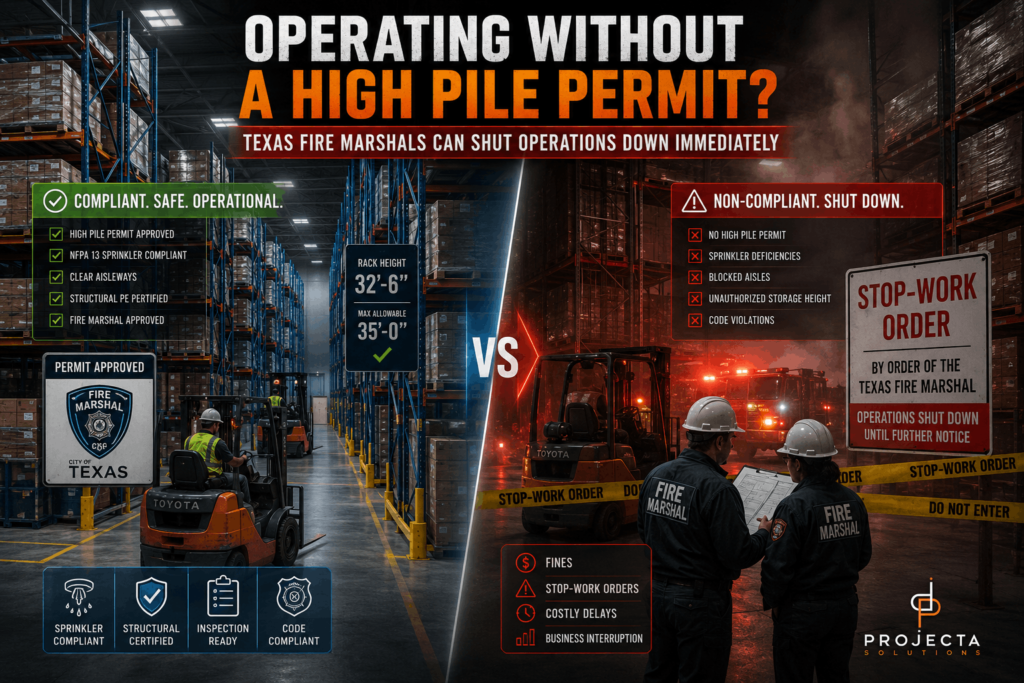
This is not a theoretical risk. Texas fire marshals conduct routine warehouse inspections — and the consequences of operating without a required permit are serious:
- Immediate Stop-Work / Stop-Operations Order: The fire marshal can immediately order you to stop warehouse operations until you achieve compliance.
- Financial Penalties: Fines vary by city but can reach $1,000–$10,000 per day of non-compliance
- Insurance Liability: Operating without required permits can void your property and liability insurance coverage in the event of a fire or rack collapse
- Re-inspection Fees: Every failed or incomplete inspection costs additional fees and adds weeks to your timeline
- Business Disruption: A stop-operations order during peak season can cost far more than the permit process itself
The cost of getting the permit done right, typically $2,000–$6,000 in engineering and filing fees for a mid-size Texas warehouse, is a fraction of the cost of a single day’s operational shutdown.
How Projecta Solutions Handles High Pile Permits End to End
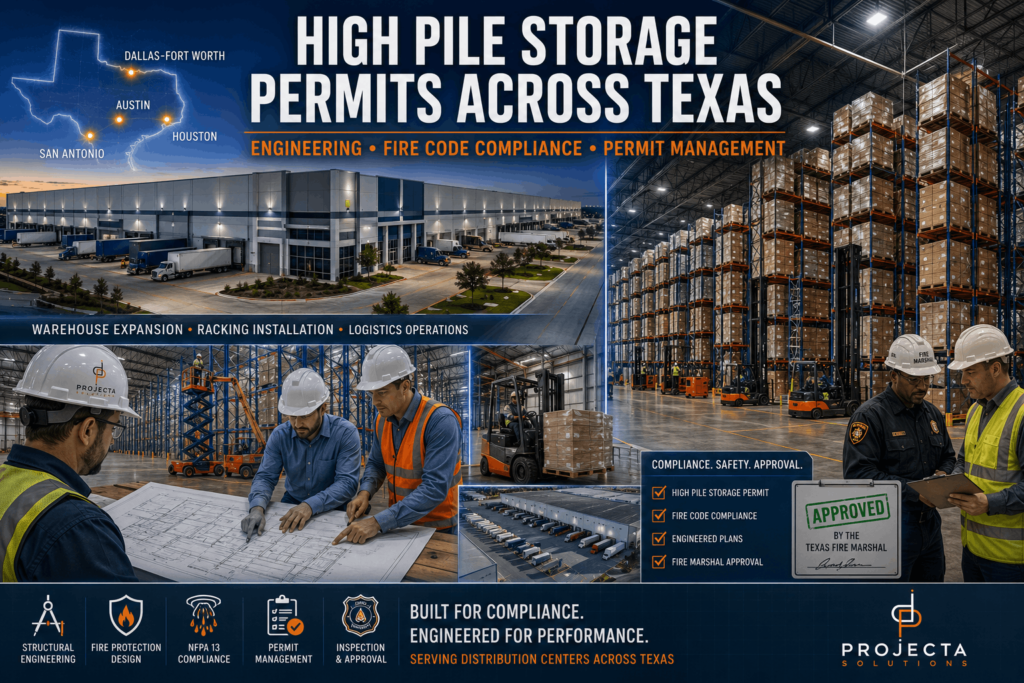
Projecta Solutions is a full-service warehouse solutions firm serving Texas and Florida. Our engineering and permitting service covers every step of the high pile storage permit process, from commodity classification and AutoCAD layout design to structural engineering, fire marshal coordination, and final inspection.
We have existing relationships with permit offices in Dallas-Fort Worth, Houston, Austin, and San Antonio, which means we know exactly what each jurisdiction requires, how to format submittals for fast review, and how to resolve revision requests without delays.
If you’re also sourcing and installing pallet racking and safety and rack protection equipment, we handle that too, one vendor, one timeline, one point of accountability from first drawing to operational warehouse.
Frequently Asked Questions
How much does a high pile storage permit cost in Texas?
Filing fees range from $200 to $1,500, depending on city and project scope. Engineering and documentation preparation (structural calculations, AutoCAD drawings, PE stamp) typically adds $2,000–$5,000. Total permit-related costs for a mid-size Texas warehouse generally run $3,000–$6,500 — a small fraction of total project cost when included upfront in your budget.
How long is a high pile storage permit valid in Texas?
Most Texas municipalities issue and renew high pile storage permits annually as operational permits. Some cities tie the permit to the facility’s certificate of occupancy. Our team confirms renewal requirements for your specific jurisdiction and can manage annual renewals on your behalf.
Can I get a high pile permit without a structural engineer?
In most Texas cities, no. Dallas, Houston, Austin, and San Antonio all require PE-stamped structural calculations for racking systems above certain heights. Attempting to file without them results in automatic rejection. Projecta Solutions includes structural engineering in every permitting engagement.
Do I need to update my sprinkler system to obtain a high pile permit?
Potentially yes. If your current sprinkler system wasn’t designed for high pile storage, it may not adequately cover tall rack configurations. The fire marshal will require documentation showing your sprinkler system meets NFPA 13 standards for your specific commodity class and storage height. We review this as part of every permitting project.
Does Projecta Solutions handle high pile storage permits in Houston and Dallas?
Yes. We handle high-pile storage permits in Dallas-Fort Worth, Houston, Austin, San Antonio, and across Texas and Florida. Our team manages the entire process — you don’t need to coordinate between separate engineers, designers, and permit runners. Contact us with your facility details, and we’ll confirm requirements and timeline for your specific location.
START YOUR HIGH PILE PERMIT TODAY
Don’t wait for the fire marshal to find you first. Projecta Solutions manages the entire Texas high pile storage permit process — commodity classification, AutoCAD design, structural engineering, fire marshal coordination, and final inspection.
- Response within 24 business hours
- Serving DFW, Houston, Austin & San Antonio
→ Contact Projecta Solutions at projectasolutions.com/contact-us/